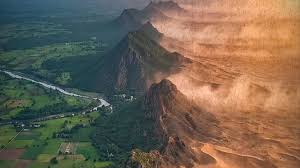
The Hon’ble Supreme Court of India vide its judgement dated 25 th December 2025, acknowledging the importance of protecting the Aravalli Ranges, have renewed public discourse on its significance. Stretched between Gujarat, Rajasthan, Delhi and Haryana, it is one of the oldest fold mountains of the world, playing a pivotal role in the evolution of Indian culture from ancient past. In fact, it would not be unfair to call it ‘the living archive’ of Indian history.
Since the prehistoric period, Aravalli ranges provided the due natural resources for the growth of human civilization. The cave paintings and stone tools found on Mangarbani, an Upper Paleolithic site, located in the Delhi Ridge of Aravallis, is one such example. Extensive availability of metals including copper along the Banas River in the Southern Aravallis Ranges paved the growth of Chalcolithic (metal + stone tools) Cultures in this region. Referred as the Ahar-Banas, this chalcolithic culture provided steady supply of utensils and weapons made of copper and stone to the Harappans. It thus facilitated the First Urban Revolution of India.
Aravallis also witnessed the rise of Matsya Mahajanpad during the Second Urban Revolution (600 BCE onwards). Biratnagar, the capital of Matsya Mahajanpad, identified within the present-day Jaipur, Rajasthan, is one of the sprawling cities that emerged at that time on the Aravalli Ranges. The discovery of Bhabru Rock edict of Ashoka in Biratnagar speaks of the continued role of Aravallis in charting Indian history. This edict articulates the administrative, philosophical and spiritual orientation of King Ashoka. Since it is addressed to the subjects, it was deliberately placed in Bhabru which is on the way of ‘Uttara path’, an ancient trade route, traversing through the Aravalli ranges and connecting Magadh (Bihar) with Taxila (Pakistan).
With the passage of time, especially by the Medieval Period, Aravallis began to play an additional role of providing safe abode for Indian rulers against imperial threats. Rajput dynasties built formidable forts like the Chittorgarh and Kumbhalgarh on the Aravallis and fought relentlessly against the expansionist menace of Sultanate and the Mughal rulers. The geography of the Aravallis ridges came as a steady support to the Rajputs. The Battle of Haldighati (18 th June 1576 AD) fought between Rana Pratap of Mewar and the Mughals is one such example. In this battle, Rana Pratap used Guerrilla method of warfare that was best suited in the narrow passes of Aravallis against the Mughal Imperial forces.
With the arrival of the Britishers on the Indian soil, the Aravallis became subject to a newfound greed and exploitation. Its forests were now targeted to meet growing timber needs for the railway line constructions. Britishers also built famous Ranges stations on Mt. Abu as a space of vacation and respite for British ‘Sahebs’. Colonizers used legislative frameworks to monopolize control over forest resources. Indian Forest Act 1865, was legislated by the British to do a systematic exploitation of the forest resources at the cost of the rights of the local population on these resources. The concept of Reserved Forest, brought in through the Indian Forest Act 1878, was the next step forward in this direction.
Thus, it is fair to say that the Aravalli stands as a living testament to the Indian historical trajectory from ancient past to the modern days. Even after years of exploitation, it is acting as the green lung of North India, preventing desertification of Delhi NCR. However, the existence of Aravalli is under threat today due to extensive mining for stones and metals. Realizing the urgency of the situation the Apex Court of India has acknowledged the threat and has intervened to safeguard the Aravallis. However, protecting the Aravallis is not just about safeguarding nature. Rather, as the above discussion shows, it is also about shielding this living archive of India from the greedy hands of the miners.